
Sai Life Sciences, Centrix and Agility Life Sciences Host Webinar on Integrated CMC Strategies to Accelerate Drug Development
1 Apr 2026
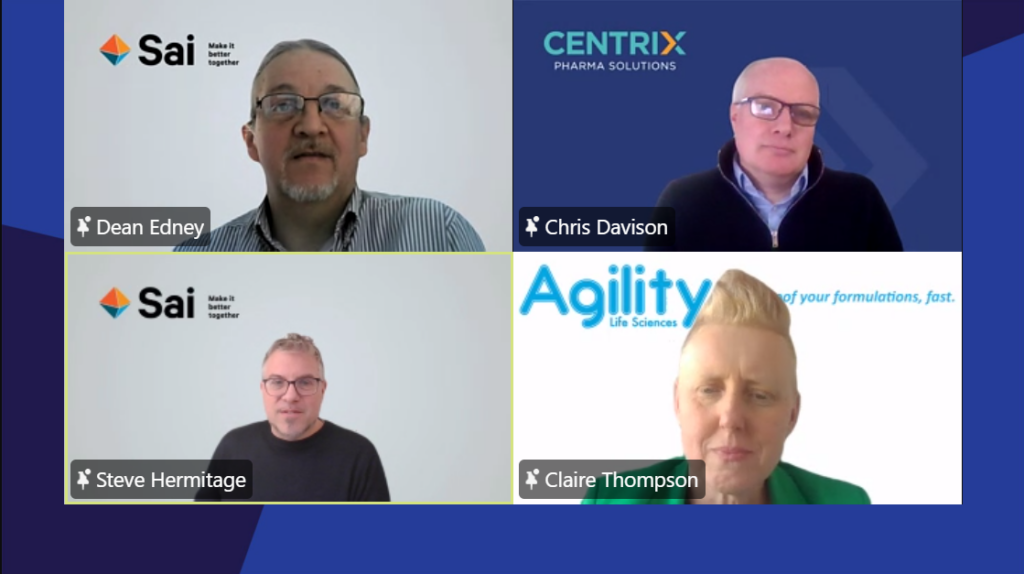
Sai Life Sciences, Centrix Pharma Solutions and Agility Life Sciences recently came together to host a webinar bringing together industry experts to discuss how integrated Chemistry, Manufacturing and Controls (CMC) strategies can streamline development, reduce risk and accelerate the journey from candidate selection to first-in-human (FIH) studies.
The session featured Dean Edney, Former Head of Process Research & Development (API) at Sai Life Sciences; Claire Thompson, Founder and Chief Executive Officer, Agility Life Sciences; and Chris Davison, Chief Executive Officer, Centrix Pharma Solutions. The discussion was moderated by Stephen Hermitage, Senior Vice President, CMC Scientific Excellence & Learning at Sai Life Sciences.
The webinar highlighted the growing need for integrated development models as biotech companies face increasing pressure to accelerate timelines while balancing cost, risk and evolving regulatory expectations. Speakers noted that traditional siloed approaches—where drug substance, drug product and manufacturing activities progress sequentially—can create inefficiencies, delays and duplication of effort. Instead, panellists emphasized the value of integrated CMC partnerships that bring together expertise across synthetic chemistry, formulation development, analytical sciences and manufacturing from the earliest stages of development.
A key theme throughout the discussion was the importance of “planning with the end in mind.” The panel noted that decisions made early in development—particularly around formulation strategies and manufacturability—can significantly influence downstream clinical and commercial outcomes. Aligning on long-term objectives earlier in the process can help reduce risk and avoid costly rework.
The speakers also discussed challenges associated with complex or “badly behaved” molecules, underscoring the need for a technology-agnostic and data-driven approach to formulation development. Selecting solutions based on molecule-specific characteristics such as solubility, stability and permeability, they noted, can help create more effective development pathways.
The conversation further explored the role of advanced data analytics and modelling in early-stage development. While artificial intelligence continues to evolve, panellists highlighted its growing potential to generate stronger insights from limited datasets, identify risks earlier and support more informed decision-making.
Another area of focus was operational efficiency. The panel highlighted how reducing duplication across drug substance and drug product workflows—particularly in analytical methods, impurity tracking and development activities—can help lower costs while improving speed and execution.
The webinar concluded with a broader discussion on how CMC strategies increasingly extend beyond traditional boundaries. Effective drug development, the panel noted, requires alignment across toxicology, clinical strategy and supply chain functions—making collaboration a key driver of speed, efficiency and long-term success.
As development pathways become increasingly complex, integrated approaches are gaining recognition as an important enabler for bringing therapies to patients faster, more efficiently and with greater confidence.
Related News

Sai Life Sciences is seeing increasing opportunities to deepen and expand customer relationships through dedicated Full-Time Equivalent (FTE) engagement models, […]
14 Aug 2026

Sai Life Sciences has inaugurated the first facility within its new Unit VIII campus in Hyderabad’s Genome Valley, marking an […]