At Sai Life Sciences, our In Vitro Biology platform delivers decision-ready, translational data that guide confident progression across the drug discovery continuum. We design, develop, and execute mechanism-driven and disease-relevant assays that validate targets, inform SAR, and de-risk candidate selection. By integrating cell-based, biochemical, and biophysical systems with high-content imaging, automation, and data analytics, our scientists generate rapid, reproducible insights that strengthen design strategies across small molecules and emerging therapeutic modalities.
Supporting Every Stage of Discovery
From early target hypotheses to candidate optimization, our in vitro biology capabilities are embedded across discovery programs: Target Identification → Target Validation → Hit Discovery (Phenotypic & Target-Based) → Hit-to-Lead → Lead Optimization → Candidate Selection
This end-to-end alignment ensures biology remains a decision engine, not a downstream checkpoint.
Our Capabilities
Target Validation & Genetic Perturbation
Functional target validation using siRNA, shRNA, and CRISPR-Cas9, supported by stable cell line generation, orthogonal confirmation strategies, and pathway-level interrogation.
Assay Development, Validation & Screening
Custom biochemical, cellular, phenotypic, and biophysical assays designed to bridge early validation with novel assay development and SAR optimization, tailored to program needs.
Mechanism of Action & Pathway Biology
Comprehensive MoA and target engagement assays, signaling pathway mapping, selectivity profiling, and mechanistic deconvolution to reduce early-stage risk and improve translational confidence.
Biochemical, Cellular & Biophysical Platforms
Integrated application of cell-based and biochemical assays alongside SPR, MST, and NanoDSF to assess binding, stability, kinetics, and molecular interactions.
Disease-Relevant & Translational Models
In vitro disease models across oncology, inflammation, neuroscience, infectious diseases, and additional therapeutic areas to ensure biological relevance and translational alignment.
High-Content Imaging & Screening
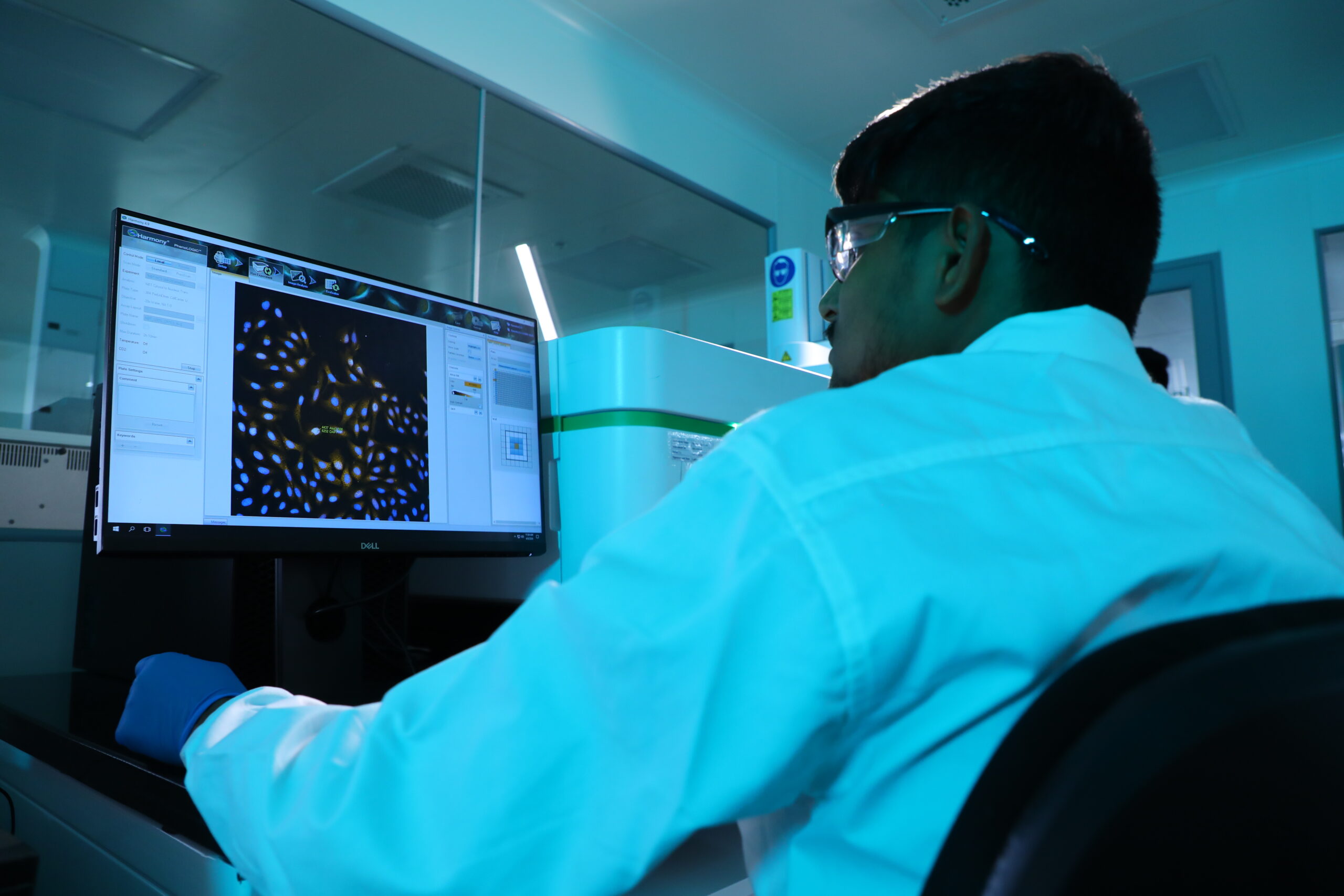
Medium- to high-throughput screening enabled by automation, high-content imaging, quantitative image analysis, and advanced data visualization.
Biomarker & Translational Biology
Biomarker discovery and validation through functional genomics, reporter assays, and pathway analysis to connect discovery signals with clinical endpoints.
Modality-Agnostic Biology
Biology support across diverse therapeutic modalities, including small molecules, degraders, peptides, large molecules, and antibody–drug conjugates (ADCs).
Structural Biology Integration
Gene-to-structure workflows that enable structural insights to inform target validation, assay design, and structure-guided discovery strategies.
Integrated DMTA Workflows
Seamless alignment with medicinal chemistry, CADD, and DMPK to enable rapid design–make–test–analyze cycles and faster progression toward candidate nomination.
Functional target validation using siRNA, shRNA, and CRISPR-Cas9, supported by stable cell line generation, orthogonal confirmation strategies, and pathway-level interrogation.
Assay Development, Validation & Screening
Custom biochemical, cellular, phenotypic, and biophysical assays designed to bridge early validation with novel assay development and SAR optimization, tailored to program needs.
Mechanism of Action & Pathway Biology
Comprehensive MoA and target engagement assays, signaling pathway mapping, selectivity profiling, and mechanistic deconvolution to reduce early-stage risk and improve translational confidence.
Biochemical, Cellular & Biophysical Platforms
Integrated application of cell-based and biochemical assays alongside SPR, MST, and NanoDSF to assess binding, stability, kinetics, and molecular interactions.
Disease-Relevant & Translational Models
In vitro disease models across oncology, inflammation, neuroscience, infectious diseases, and additional therapeutic areas to ensure biological relevance and translational alignment.
High-Content Imaging & Screening
Medium- to high-throughput screening enabled by automation, high-content imaging, quantitative image analysis, and advanced data visualization.
Biomarker & Translational Biology
Biomarker discovery and validation through functional genomics, reporter assays, and pathway analysis to connect discovery signals with clinical endpoints.
Modality-Agnostic Biology
Biology support across diverse therapeutic modalities, including small molecules, degraders, peptides, large molecules, and antibody–drug conjugates (ADCs).
Structural Biology Integration
Gene-to-structure workflows that enable structural insights to inform target validation, assay design, and structure-guided discovery strategies.
Integrated DMTA Workflows
Seamless alignment with medicinal chemistry, CADD, and DMPK to enable rapid design–make–test–analyze cycles and faster progression toward candidate nomination.
Our purpose-built In Vitro Biology laboratories are equipped with advanced liquid-handling automation, high-content imaging systems, flow cytometry, multimode plate readers, and real-time kinetic platforms. This infrastructure supports rapid screening, deep mechanistic profiling, and translational validation across diverse biological systems.
Yes. We offer both target-based and phenotypic screening, supported by integrated biochemical, cell-based, and phenotypic assay platforms to enable comprehensive hit and lead identification.
Yes. Our DMPK platform provides integrated in vitro ADME support, ensuring drug-like properties are assessed early and incorporated into discovery decision-making.
Yes. We support MoA studies through target validation, pathway analysis, phenotypic profiling, and integrated discovery workflows that align biology with chemistry and DMPK.
We apply rigorous assay validation, standardized performance metrics, and reproducibility tracking across plates, projects, and timelines, ensuring data reliability and confident downstream decisions.
Resources
Structural Biology capabilities launched with X-Ray Crystallography