Skip to content
Flyout Menu
  • About Us
    • Overview
    • The Sai Way
    • Leadership
    • Quality
    • Facilities
      • Boston
      • Manchester
      • Hyderabad
      • Bidar
  • Our Capabilities
    • Discovery
      • CADD & Structural Biology
      • Compound Management
      • DMPK (Drug Metabolism & Pharmacokinetics)
      • In Vitro Biology
      • In Vivo Pharmacology
      • Integrated Drug Discovery (IDD)
      • Safety & Toxicology
      • Synthetic & Medicinal Chemistry
    • Drug Substance Development
      • Analytical Development
      • Developability & Pre-Formulation
      • Particle Science & Engineering
      • Process Development
      • Process Engineering
      • Discovery Process Chemistry
    • Drug Substance Manufacturing
      • Engineering Technologies
      • Infrastructure
      • Product Types
    • New Modalities
      • Antibody–Drug Conjugates
      • Lipids
      • Oligos
      • Peptides
    • Formulations
      • Clinical Formulation Supplies
      • New Chemical Entity (NCE) formulation development
  • Responsibility
    • Sustainability
    • Health, Safety and Environment
    • Corporate Social Responsibility
  • Knowledge Hub
    • Newsroom
    • Newsroom – Blogs
    • Newsroom – Case Studies
  • Investors
    • Financial Information
    • Annual reports
    • Corporate Governance
    • Shareholder Services
    • Disclosures
  • Careers
  • Contact us
  • About Us
    • Overview
    • The Sai Way
    • Leadership
    • Quality
    • Facilities
    • – Boston
    • – Manchester
    • – Hyderabad
    • – Bidar
    • Overview
    • The Sai Way
    • Leadership
    • Quality
    • Facilities
    • – Boston
    • – Manchester
    • – Hyderabad
    • – Bidar
  • Our Capabilities
    • Discovery
    • Integrated Drug Discovery (IDD)
    • CADD & Structural Biology
    • Synthetic & Medicinal Chemistry
    • In Vitro Biology
    • DMPK (Drug Metabolism & Pharmacokinetics)
    • In Vivo Pharmacology
    • Safety & Toxicology
    • Compound Management
    • Discovery
    • Integrated Drug Discovery (IDD)
    • CADD & Structural Biology
    • Synthetic & Medicinal Chemistry
    • In Vitro Biology
    • DMPK (Drug Metabolism & Pharmacokinetics)
    • In Vivo Pharmacology
    • Safety & Toxicology
    • Compound Management
    • Drug Substance Development
    • Discovery Process Chemistry
    • Process Development
    • Analytical Development
    • Process Engineering
    • Particle Science & Engineering
    • Developability & Pre-Formulation
    • Drug Substance Development
    • Discovery Process Chemistry
    • Process Development
    • Analytical Development
    • Process Engineering
    • Particle Science & Engineering
    • Developability & Pre-Formulation
    • Drug Substance Manufacturing
    • Product Types
    • Infrastructure
    • Engineering Technologies
    • Formulations
    • New Chemical Entity (NCE) formulation development
    • Clinical Formulation Supplies
    • Drug Substance Manufacturing
    • Product Types
    • Infrastructure
    • Engineering Technologies
    • Formulations
    • New Chemical Entity (NCE) formulation development
    • Clinical Formulation Supplies
    • New Modalities
    • Antibody–Drug Conjugates
    • Peptides
    • Oligos
    • New Modalities
    • Antibody–Drug Conjugates
    • Peptides
    • Oligos
  • Responsibility
    • Sustainability
    • Health, Safety and Environment
    • Corporate Social Responsibility
    • Sustainability
    • Health, Safety and Environment
    • Corporate Social Responsibility
  • Knowledge Hub
    • Newsroom
    • Blogs
    • Case Studies
    • Newsroom
    • Blogs
    • Case Studies
  • Investors
    • Investor Relations
    • Financial Information
    • Annual reports
    • Corporate Governance
    • Shareholder Services
    • Disclosures
    • Investor Relations
    • Financial Information
    • Annual reports
    • Corporate Governance
    • Shareholder Services
    • Disclosures
  • Careers
  • Contact us
  • About Us
    • Overview
    • The Sai Way
    • Leadership
    • Quality
    • Facilities
    • – Boston
    • – Manchester
    • – Hyderabad
    • – Bidar
    • Overview
    • The Sai Way
    • Leadership
    • Quality
    • Facilities
    • – Boston
    • – Manchester
    • – Hyderabad
    • – Bidar
  • Our Capabilities
    • Discovery
    • Integrated Drug Discovery (IDD)
    • CADD & Structural Biology
    • Synthetic & Medicinal Chemistry
    • In Vitro Biology
    • DMPK (Drug Metabolism & Pharmacokinetics)
    • In Vivo Pharmacology
    • Safety & Toxicology
    • Compound Management
    • Discovery
    • Integrated Drug Discovery (IDD)
    • CADD & Structural Biology
    • Synthetic & Medicinal Chemistry
    • In Vitro Biology
    • DMPK (Drug Metabolism & Pharmacokinetics)
    • In Vivo Pharmacology
    • Safety & Toxicology
    • Compound Management
    • Drug Substance Development
    • Discovery Process Chemistry
    • Process Development
    • Analytical Development
    • Process Engineering
    • Particle Science & Engineering
    • Developability & Pre-Formulation
    • Drug Substance Development
    • Discovery Process Chemistry
    • Process Development
    • Analytical Development
    • Process Engineering
    • Particle Science & Engineering
    • Developability & Pre-Formulation
    • Drug Substance Manufacturing
    • Product Types
    • Infrastructure
    • Engineering Technologies
    • Formulations
    • New Chemical Entity (NCE) formulation development
    • Clinical Formulation Supplies
    • Drug Substance Manufacturing
    • Product Types
    • Infrastructure
    • Engineering Technologies
    • Formulations
    • New Chemical Entity (NCE) formulation development
    • Clinical Formulation Supplies
    • New Modalities
    • Antibody–Drug Conjugates
    • Peptides
    • Oligos
    • New Modalities
    • Antibody–Drug Conjugates
    • Peptides
    • Oligos
  • Responsibility
    • Sustainability
    • Health, Safety and Environment
    • Corporate Social Responsibility
    • Sustainability
    • Health, Safety and Environment
    • Corporate Social Responsibility
  • Knowledge Hub
    • Newsroom
    • Blogs
    • Case Studies
    • Newsroom
    • Blogs
    • Case Studies
  • Investors
    • Investor Relations
    • Financial Information
    • Annual reports
    • Corporate Governance
    • Shareholder Services
    • Disclosures
    • Investor Relations
    • Financial Information
    • Annual reports
    • Corporate Governance
    • Shareholder Services
    • Disclosures
  • Careers
  • Contact us
  • About Us
    Main Menu
    • Overview
    • The Sai Way
    • Leadership
    • Quality
    • Facilities
      • Boston
      • Manchester
      • Hyderabad
      • Bidar
  • Our Capabilities
    Main Menu
    • Discovery
      • Integrated Drug Discovery (IDD)
      • CADD & Structural Biology
      • Synthetic & Medicinal Chemistry
      • In Vitro Biology
      • DMPK (Drug Metabolism & Pharmacokinetics)
      • In Vivo Pharmacology
      • Safety & Toxicology
      • Compound Management
    • Drug Substance Development
      • Discovery Process Chemistry
      • Process Development
      • Analytical Development
      • Process Engineering
      • Particle Science & Engineering
      • Developability & Pre-Formulation
    • Drug Substance Manufacturing
      • Product Types
      • Infrastructure
      • Engineering Technologies
    • Formulations
      • New Chemical Entity (NCE) formulation development
      • Clinical Formulation Supplies
    • New Modalities
      • Antibody–Drug Conjugates
      • Peptides
      • Oligos
  • Sustainability
    • Sustainability
    • Health, Safety and Environment
    • Corporate Social Responsibility
    • Sustainability
    • Health, Safety and Environment
    • Corporate Social Responsibility
  • Knowledge Hub
    • Newsroom
    • Blogs
    • Case Studies
    • Newsroom
    • Blogs
    • Case Studies
  • Investors
    • Investor Relations
    • Financial Information
    • Annual reports
    • Corporate Governance
    • Shareholder Services
    • Disclosures
    • Investor Relations
    • Financial Information
    • Annual reports
    • Corporate Governance
    • Shareholder Services
    • Disclosures
  • Careers
  • Contact us
  • About Us
    Main Menu
    • Overview
    • The Sai Way
    • Leadership
    • Quality
    • Facilities
      • Boston
      • Manchester
      • Hyderabad
      • Bidar
  • Our Capabilities
    Main Menu
    • Discovery
      • Integrated Drug Discovery (IDD)
      • CADD & Structural Biology
      • Synthetic & Medicinal Chemistry
      • In Vitro Biology
      • DMPK (Drug Metabolism & Pharmacokinetics)
      • In Vivo Pharmacology
      • Safety & Toxicology
      • Compound Management
    • Drug Substance Development
      • Discovery Process Chemistry
      • Process Development
      • Analytical Development
      • Process Engineering
      • Particle Science & Engineering
      • Developability & Pre-Formulation
    • Drug Substance Manufacturing
      • Product Types
      • Infrastructure
      • Engineering Technologies
    • Formulations
      • New Chemical Entity (NCE) formulation development
      • Clinical Formulation Supplies
    • New Modalities
      • Antibody–Drug Conjugates
      • Peptides
      • Oligos
  • Sustainability
    • Sustainability
    • Health, Safety and Environment
    • Corporate Social Responsibility
    • Sustainability
    • Health, Safety and Environment
    • Corporate Social Responsibility
  • Knowledge Hub
    • Newsroom
    • Blogs
    • Case Studies
    • Newsroom
    • Blogs
    • Case Studies
  • Investors
    • Investor Relations
    • Financial Information
    • Annual reports
    • Corporate Governance
    • Shareholder Services
    • Disclosures
    • Investor Relations
    • Financial Information
    • Annual reports
    • Corporate Governance
    • Shareholder Services
    • Disclosures
  • Careers
  • Contact us

HTE: Unlocking the Potential of a Powerful Tool in Drug Discovery and Development

As an enabling technology, High Throughput Experimentation (HTE) has paved the way for the execution of large, parallel sets of experiments on milligram to sub-milligram scale, facilitating rapid generation of large quantities of reaction data. Key to its success is that HTE is broadly applicable across almost any reaction class, including metal-mediated cross-couplings, biocatalysis, asymmetric transformations, photochemistry, gaseous reactions and, more recently, electrochemistry.  In addition, it’s fast, data-rich and material efficient: combinations of reactants and reagents can be screened rapidly and effectively, which, when fully automated, can provide rapid readouts on a route or reaction’s viability.  

HTE is often used to accelerate reaction optimisation and identify reagents or catalysts, informing go/no-go decisions on a route or process. However, it can also be used to cover large areas of chemical space and, when used to its true potential, multiple reaction parameters can be systematically interrogated at once.  

  • In a Discovery Chemistry setting, use of HTE can significantly accelerate the DMTA cycle, and during SAR studies HTE enables rapid evaluation of multiple conditions, enabling more challenging analogues to be prepared so avoiding missed opportunities.  
  • In a Process Research and Development setting, HTE is often focussed on quickly establishing key reaction parameters as well as reaction kinetics, alongside assessing the process conditions and materials required for large-scale synthesis.  

Sai Life Sciences and ‘Islands of Automation’ 

However, while the advantages of HTE are evidential, to fully realise them there needs to be investment in both laboratory infrastructure and technical operators. This is why Sai Life Sciences have invested in both the hardware and personnel required to enable our customers’ programs to benefit from HTE, with particular attention to the concept of ‘Islands of Automation’. In this model, individual workstations are used to optimise each part of a process, or operation, in isolation. For example: one station might focus on measuring out solids; another on dispending liquids; a third on stirring, heating, or cooling the mixture; a fourth on sampling; and a fifth on analysis. This means that for each process an operational goal can be set and optimised independently. 

While generation of data can be expediated through use of specific instrumentation, the next obvious bottleneck is during interpretation and analysis, which can quickly negate all previous gains if not managed well. To this end, internal standards are used extensively within HTE processes, as they allow direct quantitative comparison of one reaction with another. LCMS or UHPLCMS are used extensively and are readily amenable to a high throughput setting. Upon analysis and data generation, tools that facilitate batch processing and visualisation of large data sets therefore become important. Impactful and simple the data representation such as pie charts and heat maps are regular features of HTE data output, enabling rapid visual scanning of results to identify key next steps, Figure 1. 
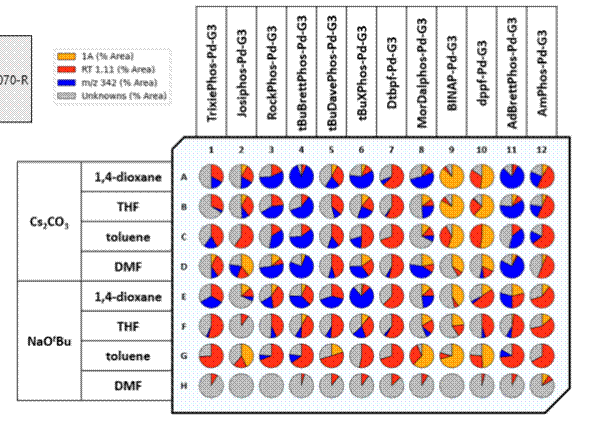
Figure 1: Representation of results in a highly visual format aids data interpretation.  

HTE in combination with AI and ML 

In recent years, the adoption of AI and ML technologies within drug discovery and process development has been rapid. However, when embedding this technology care needs to be taken, particularly in relation to the compatibility of software used by the instrumentation during results analysis as it feeds a single algorithm, or when curated into a larger database. Careful consideration of the potential future uses of larger data sets, for example in predictive modelling, provides significant advantage, therefore ensuring data input compliance with AI and ML models is crucial.  

Sai Life Science: Investing in technology 

At Sai Life Sciences, we believe in the power of technology and have invested significantly in automation of HTE processes. But automation alone is not enough, so we have also integrated our workflows, ensuring that reaction data are captured in a structured format allowing detailed interrogation. Importantly, this investment ensures that the time and cost advantages gained through use of HTE are maximised to best aid our customers, particularly during proof-of-concept and optimisation work. The following two case studies demonstrate how Sai Life Sciences has efficiently used HTE to save our clients time and money, ultimately allowing APIs and drug candidates to progress through R&D more quickly.  

Case study 1: Using HTE to bypass time-intensive SFC purification 

Our client was a pharmaceutical research organisation with a lead compound entering Phase I clinical trials. Synthesis of the API included formation of a chiral alcohol, with supercritical fluid chromatography (SFC) used for separation of the desired enantiomer. However, the process and purification were slow and unamenable to the preparation of multi-kilogram quantities required in Phase I trials. Sai Life Sciences was approached with a brief to devise a synthetic pathway that: 

  • Avoided the use of chiral chromatography for separation; 
  • Did not deviate significantly from the client’s original route, enabling rapid adoption of the new approach.  

The chiral alcohol was installed through asymmetric reduction of a ketone, which was carried through multiple stages. Within the synthetic route, four intermediates were identified that were suitable candidates, with HTE providing opportunity for rapid screening to understand the feasibility at each stage. Conditions investigated included asymmetric hydrogenation, asymmetric transfer hydrogenation and biocatalytic reduction. For each ketone, our HTE team evaluated over 200 sets of conditions, with only 4 – 5 g of each ketone required in total. Promising results, where reactions proceeded with >80% conversion and >85% ee, were triaged and subjected to manual work-up. 

Of the four possible ketone substrates, one was rapidly discounted due to issues with chemoselectivity. Viable conditions were identified for the remaining three candidates, then a subsequent cost comparison of all methods was conducted and a recommendation provided to the client. Overall, a significant amount of time was saved, facilitating rapid progression of the API into the clinic.  

Case study 2: Strategic use of HTE in route selection 

The second case study involved route selection for a late-stage API. The overall goal was to establish a new route that enabled later-phase clinical activities – the customer’s original route presented numerous issues, most notably a difficult separation of enantiomers in the final product because an asymmetric route could not be established.  

The team at Sai Life Sciences devised and evaluated several alternative approaches. The most promising contained three key steps: a Suzuki–Miyaura coupling, an asymmetric C–C bond formation (that in the literature only afforded low yields and an asymmetric variant was unknown), and a C–H activation/functionalisation. For each of the steps, an HTE approach was followed, only small quantities of material were required, and up to 96 reactions were undertaken in parallel. In particular: 

  • In the Suzuki–Miyarua coupling, extensive and rapid screening of catalysts, ligands, solvents and bases with HTE allowed substitution of the aryl halide coupling partner from a costly bromoester to a chloroacid. This had the added benefit of removing an additional step for ester hydrolysis. 
  • Rapid screening of carbon nucleophile addition into ketone substrates was undertaken, which demonstrated the first asymmetric synthesis of the target API using a chiral metal complex. 
  • C–H activation, a key late-stage convergent step, required significant exploration; yields were often poor with variation between batches. Evaluation of a range of additives and solvents enabled identification of conditions that were unprecedented in the literature but proved reliable and gave excellent yields.   

Overall, the use of HTE facilitated route development and preparation of the API on multi-kilogram scale, with both excellent yield and enantioselectivity, and allowed exploration of chemical space away from the published literature, opening new avenues for investigation and revealing conditions that may not have been discovered under a non-HTE approach. In addition, transitioning the synthesis to scale-up in the process plant was expediated, allowing rapid preparation of GMP-quality material.  

Conclusions 

The use of HTE within drug discovery and process development is a powerful tool that continually presents time and cost advantages  and can enable us to find solutions to problems that might not arise through more traditional approaches.  
At Sai Life Sciences, we are leaders in the use of HTE: from reaction design where we exploit the use of robotics for reaction set-up to in-depth analysis of large datasets. We proudly work with our customers to identify their needs, engineer bespoke solutions and drive projects forward. 

  • Sai Editorial
  • 3 Jun 2026
Link X-twitter Facebook Linkedin

Related Articles

  • Admin
  • - 13 May 2026

Dhruva – Intelligent Process Flow & Risk Evaluation Platform

Dhruva is our in-house digital application developed to automate Process Flow Diagrams (PFDs) and proactively identify potential risks associated with […]

  • Admin
  • - 13 May 2026

Contribution to ISPE Good Practice Guide: Technology Transfer

Sai Life Sciences contributed a case study to the International Society for Pharmaceutical Engineering (ISPE) Good Practice Guide: Technology Transfer […]

  • Sundeep Mallipudi
  • - 9 Aug 2024

Sai Scientists author review article on ‘Liver-on-Chips for Drug Discovery and Development’

In a review article published in the latest edition of Materials Today Bio, titled ‘Liver-on-Chips for Drug Discovery and Development,’ […]

1 / 41234

DS-7, IKP Knowledge Park,
Turkapally Village, Shameerpet Mandal,
Medchal-Malkajgiri District-500078,
Telangana, India

Company
Main Menu
  • About Us
  • Investors
  • Careers
  • Contact us
Our Capabilities
Main Menu
  • Discovery
  • Drug Substance Development
  • Drug Substance Manufacturing
  • Formulations
  • New Modalities
Knowledge Hub
Main Menu
  • News
  • Blogs
  • Case Studies
Legal
Main Menu
  • Corporate Policies
  • Privacy Policy
  • Cookie Policy
  • Terms & Conditions

© 2026 Sai Life Sciences All rights reserved.

Facebook-f Instagram Linkedin-in X-twitter Youtube